acupuncture for hair PULSE TCM CLINIC
INSIGHTS & WELLNESS

The TCM’s way of combating Hair Loss

There are several types of hair loss and it can happen to anyone at any point of time. The causes of hair loss are different due to gender, age, genetics, diet (malnutrition, anorexia), environmental factors (stress, pollutants, chemicals, etc.) and health conditions (thyroid disorders, autoimmunity, anaemia, etc.).

There are several types of hair loss and it can happen to anyone at any point of time. The causes of hair loss are different due to gender, age, genetics, diet (malnutrition, anorexia), environmental factors (stress, pollutants, chemicals, etc.) and health conditions (thyroid disorders, autoimmunity, anaemia, etc.).

There are also several types of treatments available, from western medication, hair transplant, homeopathy to even hypnosis. Countless clinical trials and researches had been done in search of finding the cure for hair loss and, of which, acupuncture has shown high efficacy in restoring hair health. One study even mentioned that the combination of acupuncture and plum blossom hammer outperformed the combination of Minoxidil and multivitamins in treating alopecia. Similar to western treatment, it would take a few months of TCM treatments to see significant and long lasting results, though without the side effects.
types of hair loss pulse tcm clinic

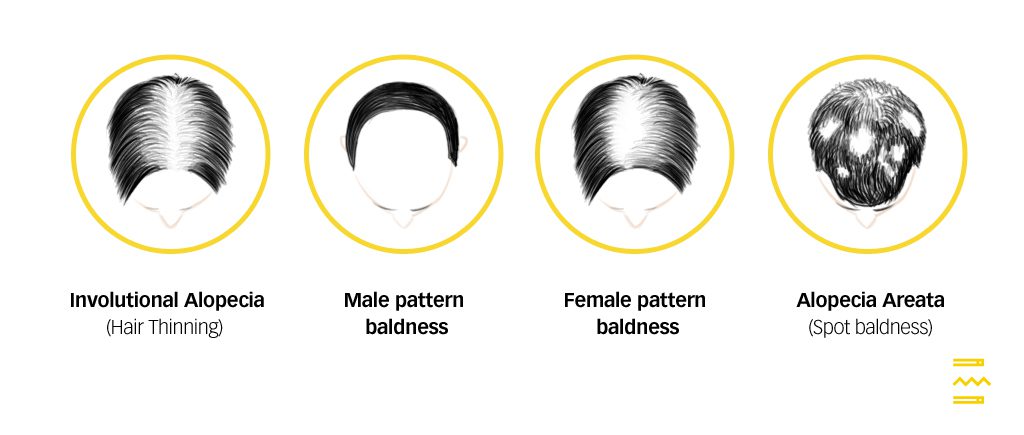
Acupuncture can help in different types of hair loss. For example, in alopecia areata, acupuncture may help reduce the immune reactions that are causing the bald patch; while in male pattern baldness, it reduces the DHT level locally. In more common conditions where the hair follicles are damaged by physical/chemical factors, acupuncture stimulates the nerve endings and increases blood circulation to accelerate the healing process, thus expediting hair growth.

TCM treatments are administered with respect to the different diagnostic pattern(s) the patient has. The more common presentations are blood-heat, ‘Qi’ and blood stasis, ‘Qi’ and blood deficiency, as well as liver and kidney deficiency. Chinese herbs can also be used in tandem with acupuncture to bring the system back in balance. Common herbs used include Platycladus orientalis (侧柏叶), Paeonia suffruticosa (牡丹皮), Eclipta prostrata (墨旱莲) to remove blood-heat; Angelica sinensis (当归), Astragalus (黄芪), Fructus Mori (桑椹) to build up the body’s ‘Qi’ and blood; Saffron flower (红花), Salvia miltiorrhiza (丹参), Ligusticum striatum (川芎) to improve ‘Qi’ and blood circulation; and Chinese knotweed (何首乌), Rehmannia glutinosa (熟地), White peony root (白芍), Cuscuta (菟丝子) to nourish the kidney and liver.

If you would like to explore TCM treatments for hair loss, book an appointment with us or learn more bout the PULSE TCM Hair Loss Programme

Frequently Asked Questions (FAQs)

While acupuncture and herbal medicine start working on internal imbalances immediately, visible hair regrowth typically follows the natural hair follicle cycle. Patients generally observe a reduction in active hair fall within 4 to 8 weeks, with noticeable new "baby hair" growth appearing after 3 to 6 months of consistent treatment.
Yes, TCM can often complement Western hair loss treatments. While Western medications focus on DHT blocking or direct follicle stimulation, TCM addresses the underlying "Qi" and blood deficiencies that may be hindering those treatments. It is important to inform your TCM physician of any current medications so they can tailor your herbal prescription safely.
The Plum Blossom (or Seven-Star) needle is a specialized TCM tool used for "dermal tapping." Unlike standard acupuncture, it lightly taps the scalp's surface to cause micro-stimulation. This technique is highly effective for waking up dormant follicles, releasing scalp tension, and improving local blood circulation to ensure nutrients reach the hair roots.
TCM is most effective for conditions where the hair follicles are still active but "weak," such as thinning hair, postpartum hair loss, or alopecia areata. If a hair follicle has completely scarred over (permanent baldness), TCM may not be able to regrow hair in that specific spot, but it can be vital in strengthening the surrounding hair to prevent further recession.
In TCM, hair health is closely linked to the Liver and Kidney systems. To maximize treatment results, it is recommended to reduce the intake of "damp-heat" inducing foods—such as excessively oily, spicy, or sugary items—as these can lead to an oily scalp and clogged follicles, which counteract the benefits of herbal therapy.
Absolutely. TCM views an oily, itchy scalp as a "Damp-Heat" internal imbalance. Along with acupuncture, physicians often prescribe specific herbs like Coptis Chinensis (Huang Lian) to clear this internal heat. Balancing the scalp's environment is often the first step in the TCM protocol before focusing on regrowth.

Acupuncture for the scalp is generally very well-tolerated. The needles used are significantly thinner than those used for vaccinations. Most patients feel a slight tingling or a "heavy" sensation, which indicates the movement of "Qi" (energy). Many find the sessions relaxing as they help reduce systemic stress, a major contributor to hair loss.

References

  • National Center for Complementary and Integrative Health. (2019, April). Traditional Chinese medicine: What you need to know. NCCIH. https://www.nccih.nih.gov/health/traditional-chinese-medicine-what-you-need-to-know/
  • World Health Organization: WHO. (2019, November 25). Traditional, complementary and integrative medicine. https://www.who.int/health-topics/traditional-complementary-and-integrative-medicine
  • Liang, Y., Yuan, J., Shazada, N. E., Jiang, J., & Wu, J. (2022). Traditional Chinese Medicine Treatment for Androgenetic Alopecia Based on Animal Experiments: A Systematic Review and Meta-Analysis. Evidence-based complementary and alternative medicine : eCAM, 2022, 2588608. https://doi.org/10.1155/2022/2588608
  • Ministry of Health Singapore (MOH). (n.d.). TCM Practitioners. [ Ministry of Health Singapore - moh.gov.sg ]
  • Li, F., Zhang, L., Li, Y., & Zheng, X. (2026). Anwuligan promotes the transition of the hair follicle cycle via the Wnt/β-catenin signaling pathway. Frontiers in pharmacology, 16, 1704083. https://doi.org/10.3389/fphar.2025.1704083
  • Original Article Author: Physician Joyce Chee