

INSIGHTS & WELLNESS

Struggling to Conceive? 5 Signs Stress Could Be Affecting Your Fertility

Nobody really warns you about how much your stress levels can secretly influence your body when you’re trying to conceive. This TCM guide highlights 5 common signs of body imbalance that may be affecting your health and ability to conceive.

When you’re in the thick of a fertility journey, it’s easy to focus entirely on ovulation tests and calendar apps. But in Traditional Chinese Medicine (TCM), we look at your body as a whole ecosystem. Constant stress doesn’t just make you tired—it actively disrupts your energy flow (Qi stagnation) and depletes the body’s resources needed to support fertility, conception, IVF success, and pregnancy.

Your body might actually be trying to tell you it’s overwhelmed right now.

Here are the 5 physical signs that stress may be impacting your fertility health and ability to conceive naturally or with IVF support. If you recognise these symptoms, take a deep breath. Your body isn’t failing you; it’s just asking for a little extra support and balance.

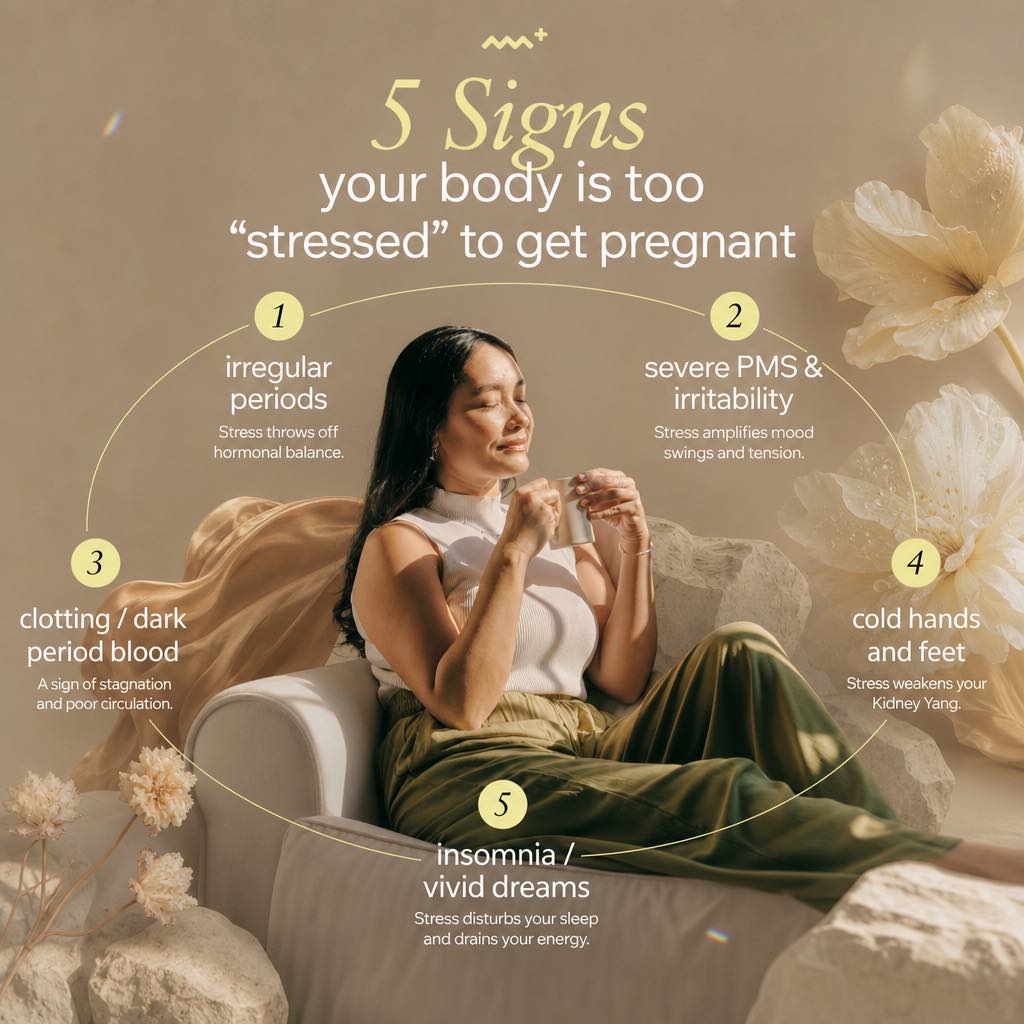
5 Signs your body is too “stressed" to get pregnant (TCM fertility perspective)
fertility-stress-warning-signs-tcm

1. Irregular Periods

Stress affects your follicular phase, leading to hormonal imbalance and irregular menstrual cycles or missed periods, often seen in women seeking fertility treatment in Singapore. This may reflect a deficiency in Kidney Yin and Blood.

2. Severe PMS & Irritability

Classic signs of Liver Qi Stagnation. If you feel highly emotional, anxious, or experience intense breast tenderness before your period, your stress may be actively blocking your energy flow—affecting your reproductive health and ovulation cycle regulation.

3. Clotting / Dark Period Blood

When Qi stagnates for too long, it can lead to Blood Stasis. In TCM fertility diagnosis, dark blood, clots, or painful cramps may indicate poor circulation caused by stress, which may affect the uterus and implantation support during IVF or natural conception.

4. Cold Hands and Feet

Are your feet and hands always cold? Stress saps your Kidney Yang, leaving the womb too “cold” for an embryo to implant. In TCM fertility care, this is often linked to reduced warmth in the uterus, which may affect embryo implantation and reproductive readiness.

5. Insomnia / Vivid Dreams

If stress keeps you up at night or causes restless, dream-disturbed sleep, it may affect Heart and Liver Blood, leaving your uterus lacking the nourishment it needs to sustain a pregnancy. This is commonly associated with stress-related fertility challenges and difficulty conceiving naturally or with IVF support.

If any of the signs above resonate with you, you are not alone. Visit our TCM physicians for a fertility assessment and learn how TCM can help manage stress and support fertility.
Nobody really warns you about how much your stress levels can secretly influence your body when you’re trying to conceive. This TCM guide highlights 5 common signs of body imbalance that may be affecting your health and ability to conceive.

When you’re in the thick of a fertility journey, it’s easy to focus entirely on ovulation tests and calendar apps. But in Traditional Chinese Medicine (TCM), we look at your body as a whole ecosystem. Constant stress doesn’t just make you tired—it actively disrupts your energy flow (Qi stagnation) and depletes the body’s resources needed to support fertility, conception, IVF success, and pregnancy.

Your body might actually be trying to tell you it’s overwhelmed right now.

Here are the 5 physical signs that stress may be impacting your fertility health and ability to conceive naturally or with IVF support. If you recognise these symptoms, take a deep breath. Your body isn’t failing you; it’s just asking for a little extra support and balance.

5 Signs your body is too “stressed" to get pregnant (TCM fertility perspective)

fertility-stress-warning-signs-tcm

1. Irregular Periods

Stress affects your follicular phase, leading to hormonal imbalance and irregular menstrual cycles or missed periods, often seen in women seeking fertility treatment in Singapore. This may reflect a deficiency in Kidney Yin and Blood.

2. Severe PMS & Irritability

Classic signs of Liver Qi Stagnation. If you feel highly emotional, anxious, or experience intense breast tenderness before your period, your stress may be actively blocking your energy flow—affecting your reproductive health and ovulation cycle regulation.

3. Clotting / Dark Period Blood

When Qi stagnates for too long, it can lead to Blood Stasis. In TCM fertility diagnosis, dark blood, clots, or painful cramps may indicate poor circulation caused by stress, which may affect the uterus and implantation support during IVF or natural conception.

4. Cold Hands and Feet

Are your feet and hands always cold? Stress saps your Kidney Yang, leaving the womb too “cold” for an embryo to implant. In TCM fertility care, this is often linked to reduced warmth in the uterus, which may affect embryo implantation and reproductive readiness.

5. Insomnia / Vivid Dreams

If stress keeps you up at night or causes restless, dream-disturbed sleep, it may affect Heart and Liver Blood, leaving your uterus lacking the nourishment it needs to sustain a pregnancy. This is commonly associated with stress-related fertility challenges and difficulty conceiving naturally or with IVF support.

If any of the signs above resonate with you, you are not alone. Visit our TCM physicians for a fertility assessment and learn how TCM can help manage stress and support fertility.

Frequently Asked Questions (FAQs)

We recommend wearing loose, comfortable clothing that can easily be rolled up above the elbows and knees. It is also best to have a light meal or snack 1 to 2 hours before your appointment to prevent lightheadedness. Avoid arriving on an empty stomach, and refrain from consuming alcohol or heavy, greasy meals prior to your visit.
For your very first visit, expect to spend about 45 to 60 minutes at the clinic, as your physician will conduct a comprehensive health assessment before the treatment. Follow-up acupuncture sessions are generally shorter, typically taking about 30 to 45 minutes.
Because TCM aims to treat the root cause rather than just suppressing symptoms, it typically takes about 3 to 6 menstrual cycles (3 to 6 months) of consistent treatment to see significant, lasting regulation in your cycle. However, many patients experience relief from pain and PMS much sooner.
While results vary, most patients see the best outcomes with a consistent 3 to 6- month program. This aligns with the natural follicular cycle to optimize egg quality and uterine lining.

References

  • Ng, E. H., So, W. S., Gao, J., Wong, Y. Y., & Ho, P. C. (2008). The role of acupuncture in the management of subfertility. Fertility and sterility, 90(1), 1–13. https://doi.org/10.1016/j.fertnstert.2008.02.094 | PMID: 18440533 DOI: 10.1016/j.fertnstert.2008.02.094
  • Huang, D. M., Huang, G. Y., Lu, F. E., Stefan, D., Andreas, N., & Robert, G. (2011). Acupuncture for infertility: is it an effective therapy?. Chinese journal of integrative medicine, 17(5), 386–395. https://doi.org/10.1007/s11655-011-0611-8 | PMID: 21611904 DOI: 10.1007/s11655-011-0611-8
  • National Center for Complementary and Integrative Health. (2019, April). Traditional Chinese medicine: What you need to know. NCCIH. https://www.nccih.nih.gov/health/traditional-chinese-medicine-what-you-need-to-know/
  • World Health Organization: WHO. (2019, November 25). Traditional, complementary and integrative medicine. https://www.who.int/health-topics/traditional-complementary-and-integrative-medicine
  • Liao, Y. H., Lin, J. G., Lin, C. C., Tsai, C. C., Lai, H. L., & Li, T. C. (2020). Traditional Chinese Medicine Treatment Associated with Female Infertility in Taiwan: A Population-Based Case-Control Study. Evidence-based complementary and alternative medicine : eCAM, 2020, 3951741. https://doi.org/10.1155/2020/3951741 | PMCID: PMC7749771 PMID: 33381200
  • Zhang, H., Zhao, M., Wu, Z., Wang, X., Jiang, Y., Liang, J., & Chen, H. (2022). Effects of Acupuncture, Moxibustion, Cupping, and Massage on Sports Injuries: A Narrative Review. Evidence-based complementary and alternative medicine : eCAM, 2022, 9467002.
    [ PMID: 35668787 | PMCID: PMC9167071 | DOI: 10.1155/2022/9467002 ]
    https://pubmed.ncbi.nlm.nih.gov/35668787/
  • Liu, A. R., Zhu, Q., Li, J., Cao, Y., Pei, T., & Shi, L. (2025). Efficacy of Acupuncture and Pharmacotherapy for Migraine Prophylaxis: A Systematic Review and Meta-Analysis. Journal of pain research, 18, 2521–2540. https://doi.org/10.2147/JPR.S519846
  • Ministry of Health Singapore (MOH). (n.d.). TCM Practitioners. [ Ministry of Health Singapore - moh.gov.sg ]