
Hands resting on the lower abdomen for menstrual cycle care at PULSE TCM

Insights · Women's Health

Introduction to your Monthly Affair

Regularity, flow, colour, and viscosity tell whether a cycle sits in a normal range or needs a closer read. TCM links those clues to Kidney, Spleen, Liver, and the Chong and Ren meridians.

In brief

A typical cycle runs about 28 to 30 days, with 3 to 7 days of bleed and roughly 50 to 80 ml of flow. Length that shifts by more than 7 days for more than two consecutive cycles reads as abnormal (advanced ≤21 days; delayed ≥37 days). Colour and viscosity are read with constitution. Kidney essence (天癸), Spleen blood production, Liver Qi, and the Chong and Ren meridians frame the cycle.

01 · Cycle basics

What is a menstrual cycle?

FSH · LH · estrogen · progesterone

Most people begin menstruating around ages 11 to 14 and continue until menopause around ages 48 to 55. Cycles usually run about 28 to 30 days, with bleed lasting 3 to 7 days.

The cycle is regulated by follicle-stimulating hormone (FSH), luteinising hormone (LH), estrogen, and progesterone in a delicate balance. At puberty, the hypothalamus signals the pituitary to release FSH and LH. Those hormones drive estrogen and progesterone shifts for ovulation and the uterine lining. If fertilisation does not occur, estrogen and progesterone fall, the endometrium sheds, and another cycle begins.
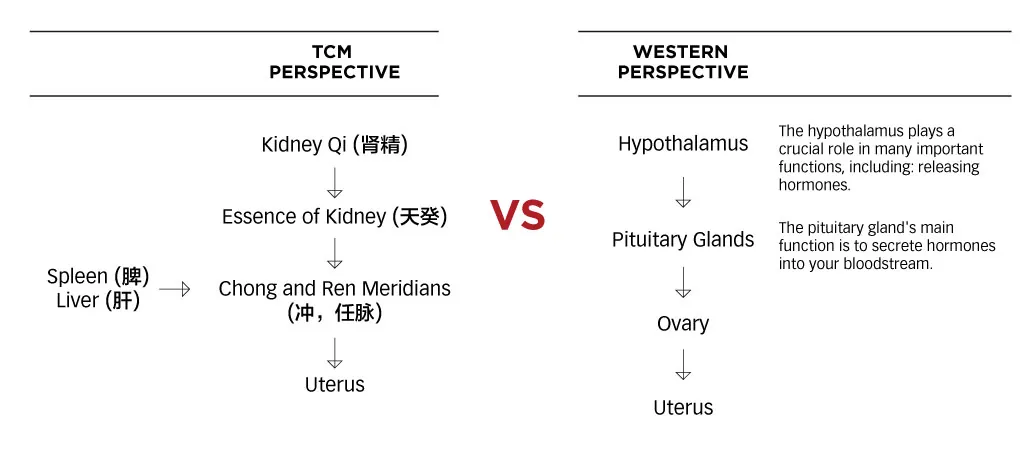
Flowchart comparing Western hormone axis and TCM organ pathways for the menstrual cycle

02 · Two lenses

Western medicine vs TCM

天癸 · 肾精 · 脾 · 肝 · Chong · Ren

Western care emphasises the hypothalamus-pituitary hormone axis. A small hormone shift can show as irregular periods. TCM reads congenital Kidney essence (天癸), Kidney essence (肾精), Spleen food-to-blood work, Liver Qi and Blood, and the Chong and Ren meridians that supply the uterus.

The Ren meridian regulates the uterus; the Chong meridian acts as a blood reservoir for it. Ample congenital Kidney essence with balanced Spleen and Liver function keeps surplus Qi and Blood moving through the uterus so menstruation stays regular. When organs and meridians are ample, the cycle tends to arrive on time.

03 · Assessment

What physicians usually look for

Cycle detail and accompanying signs reflect constitution. From there a physician can narrow the root pattern and shape a plan.

  • Regularity (周期,经期): how long the cycle and bleed last, and how steady the timing is.
  • Blood flow (经量): light, average, or heavy across the period.
  • Blood colour (血色): light, bright, dark, or dull tones.
  • Blood viscosity (质地): watery, usual, or thick with clots.
  • Accompanying signs: acne, flu-like feel, headache, breast changes, bloating, cramps, lower backache, loose stools or constipation.

04 · Singapore

Why cycles scramble in a hot climate

Lifestyle cold · desk hours

Living in Singapore, everyday cold habits can still chill the low belly and slow Qi and Blood even when the weather is warm.

  • Iced drinks: frequent bubble tea, iced coffee, and cold desserts cool the Stomach and uterus pathways.
  • Air-conditioning: long hours with midriff or feet exposed constrict local flow.
  • Desk hours: long sitting slows pelvic Qi and Blood, so timing, colour, and clots can shift across consecutive cycles.

05 · Definitions

Understanding normal vs abnormal

Use these clinic thresholds as a map, not a self-diagnosis. Patterns that persist across consecutive cycles matter more than a single odd month.

Cycle length (周期)
Pattern Threshold
Normal menstrual cycle (正常周期) Usually 28 to 30 days; a few days of variation between cycles is common.
Abnormal menstrual cycle (异常周期) Shortened or delayed by more than 7 days for more than 2 consecutive cycles.
Advanced menstruation (月经先期) Cycle of 21 days or fewer for at least 2 consecutive cycles.
Delayed menstruation (月经后期) Cycle of 37 days or more for at least 2 consecutive cycles.
Irregular menstruation (月经先后不定期) Mixed shortened and delayed cycles for at least 3 consecutive cycles.
Bleed length (经期)
Pattern Threshold
Normal menstruation period Usually about 3 to 7 days.
Abnormally short period Bleed lasting 2 days or less.
Prolonged menstruation period Bleed lasting beyond 7 to 14 days.

Flow volume

Normal vs abnormal blood flow (经量)

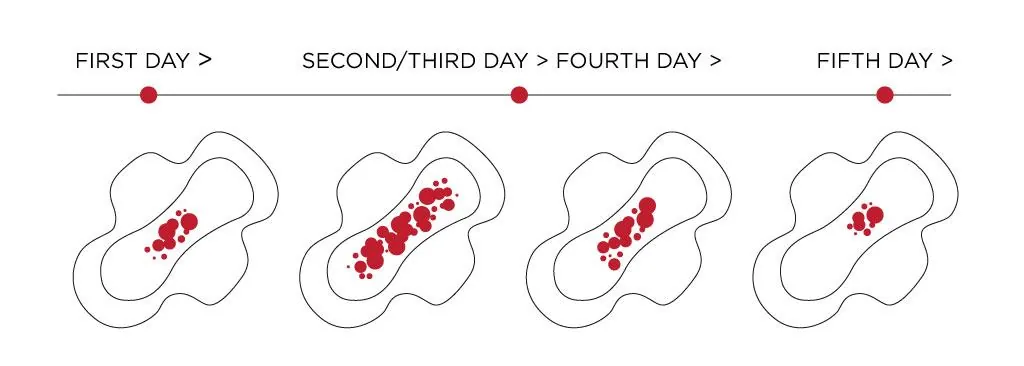
Average flow is about 50 to 80 ml per period. Heavier flow often comes in the first days, then lighter flow or spotting as the period ends. Spotting just after a period can be ordinary; prolonged bleeding or spotting for more than 5 to 7 days is a concern.

  • Abnormally heavy bleeding and/or a prolonged period
  • Bleeding or spotting between periods
  • Bleeding after sexual intercourse
  • Bleeding after menopause
  • Abnormally light bleeding and/or a very short period
Day-by-day pad illustration of menstrual flow volume across a period

06 · Colour and viscosity

What your blood colour and viscosity mean

血色 · 质地 · Yin-Yang

Light watery red often sits with Blood and Qi deficiency. Bright red with heat or Yin deficiency. Dark or purplish thick flow with damp-heat, Qi stagnation and Blood stasis, or coagulated cold in the uterus. Match accompanying symptoms before naming a pattern alone.

Colour × viscosity patterns
Colour × viscosity Pattern Common accompanying signs
Light red · light / watery Blood and Qi deficiency; or Spleen and Kidney deficiency
  • Pale skin and fingertips; low energy even after rest
  • Bloating, watery stools; giddiness; weak lower back and knees
Red · medium consistency The norm Similar tone and viscosity to bleeding from a cut; little to no clots
Bright red · medium Yin deficiency / hyperactivity of Yang (heatiness) Thirst; red flushes; irritability; constipation
Bright red · heavy / thick with clots Damp-heat Sluggishness; bitter or sticky mouth; body-heavy feel; abnormal vaginal discharge
Dark red · heavy / thick with clots Damp-heat; or Qi stagnation with Blood stasis Lower-abdomen cramps; clots; breast tenderness, lumps, pain, or bloating; emotional swings
Purplish / dull red · heavy Coagulated cold in the uterus Cramps; abdomen feels cold; irregular cycle timing

07 · Drivers

Common causes of irregular cycles

These drivers often stack. Track which ones sit with your timing, colour, and flow before a visit.

1. Stress

Liver Qi stalls under chronic stress, so cycles can arrive early, late, or clotty with breast and mood swings.

2. Irregular diet or eating disorders

Skipped meals, extreme restriction, or heavy iced and raw food weaken Spleen blood production and can thin or delay the bleed.

3. Over-exercising

Excess training without recovery depletes Qi and Blood, so periods may shorten, lighten, or pause.

4. Long-term medicines

Hormonal contraceptives and other long-course medicines can change timing and flow; bring the list to your consult.

5. Underlying medical conditions

Thyroid disease, PCOS, fibroids, endometriosis, and anaemia need Western assessment alongside TCM pattern work.

08 · Clinic

How TCM can help

A physician matches herbs, acupuncture, cupping, and moxibustion to the pattern under the calendar, not only to the bleed date.

  • Deficiency (light watery flow, fatigue): herbs and acupuncture to nourish Blood and Qi; dietary therapy to rebuild Spleen production.
  • Heat or damp-heat (bright or sticky thick flow): clearing herbs and acupuncture; skip heavy warming teas until the pattern cools.
  • Qi stagnation with Blood stasis (dark clots, cramps, breast tension): moving acupuncture and herbs; cupping when local stagnation sits with pain.
  • Coagulated cold (purplish flow, cold low belly): warming moxibustion and herbs with acupuncture to restore flow.
Explore the Women's Health programme

09 · Daily habits

Lifestyle habits for a steadier monthly cycle

  • Keep a steadier outlook and reduce chronic stress load where you can.
  • Eat foods rich in iron, potassium, and calcium, plus vitamins B and C.
  • Aim for about 8 hours of sleep and moderate exercise.
  • Practise personal hygiene during the period to lower infection risk.
  • Track cycle dates, flow, colour, clots, and accompanying symptoms so irregularities show earlier.

10 · Self-press

Acupressure points for cycle support

Massage these points for one to two minutes daily. Skip strong SP6 pressure in pregnancy.

Illustration locating Zu San Li ST36 below the outer kneecap

Acupoint

Zu San Li (ST36 · 足三里)

Supports Stomach Qi and everyday vitality when cycles feel depleted. Locate about four finger-widths below the outer kneecap dent.

Press Zu San Li (ST36)
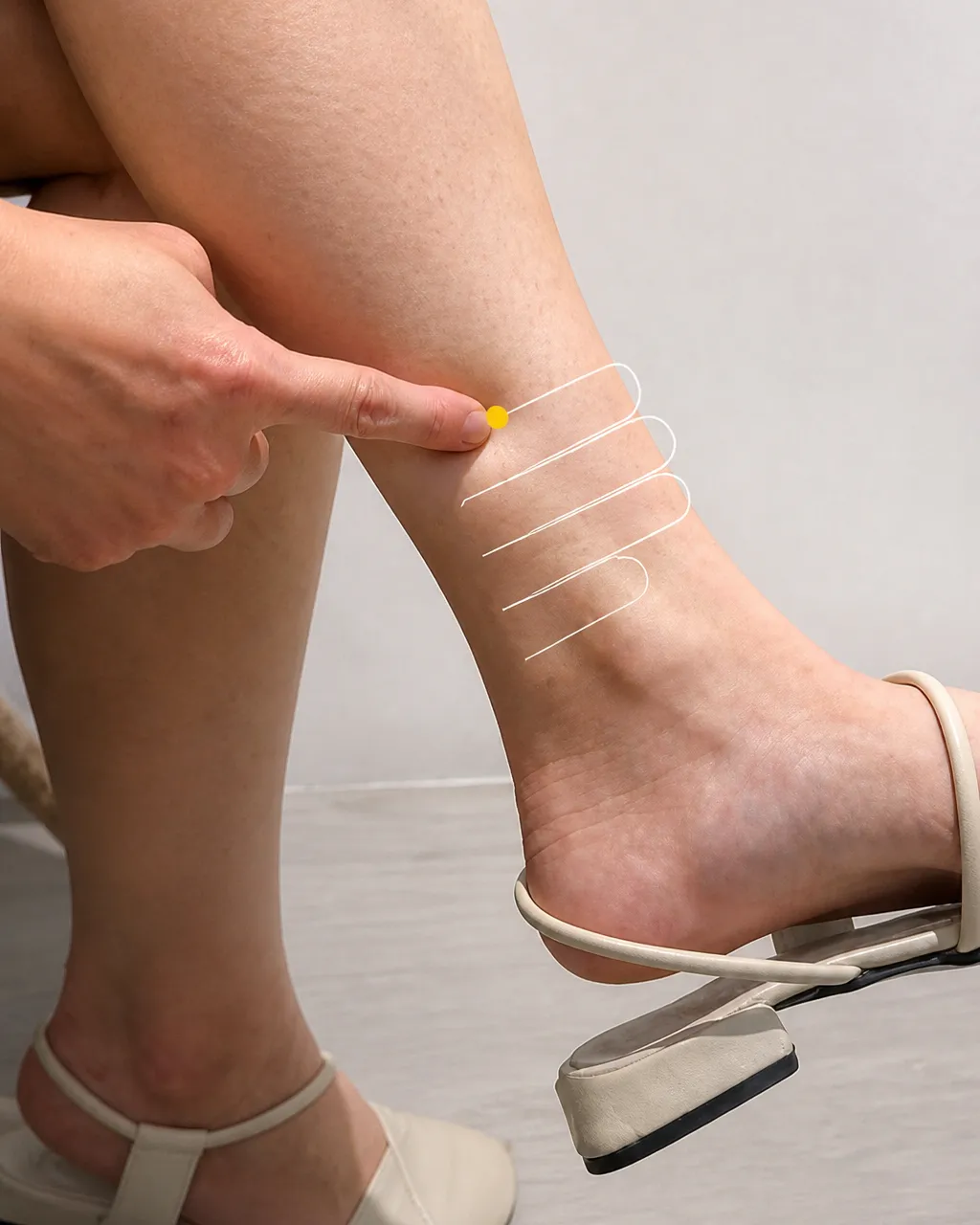
Illustration locating San Yin Jiao SP6 on the inner leg

Acupoint

San Yin Jiao (SP6 · 三阴交)

Meets Liver, Spleen, and Kidney channels; a classic point for cycle timing and lower-jiao comfort.

Skip strong SP6 pressure in pregnancy unless a physician has advised it.

Press San Yin Jiao (SP6)
Palm on the kneecap with thumb tip marking Xue Hai SP10 on the inner thigh vastus medialis bulge

Acupoint

Xue Hai (SP10 · 血海)

The “sea of Blood” on the inner thigh supports flow and stasis patterns when colour and clots need everyday care. Landmark with palm on the kneecap and thumb on the inner thigh.

Find Xue Hai (SP10)
Dr Sim Beng Joo

Clinically reviewed

Reviewed by Sim Beng Joo

Advisor (Science & Strategy) / Consultant Physician · TCMPB T1303003A

MOH-licensed TCM physician and biomedical scientist, with clinical work in digestion, pain, sleep or fatigue, and women's health patterns including cycle comfort.

View full profile

Educational information based on clinical experience and TCM principles. Not a substitute for personalised consultation, gynaecology, or urgent care. Speak with a licensed TCM physician or your doctor before starting herbs, strong self-press, or new self-care in pregnancy or with heavy bleeding. Seek urgent care for soaking through protection hour after hour, fainting, or bleeding after menopause.

FAQs

Cycle questions, answered

Common questions on length, flow, colour, and when a cycle needs a clinic read.

What is a normal menstrual cycle length?

Cycles are usually about 28 to 30 days, with a few days of natural variation. Bleed length is typically 3 to 7 days. Menarche often arrives around ages 11 to 14, and cycles continue until menopause around ages 48 to 55.

When is a menstrual cycle considered abnormal?

When a cycle shortens or delays by more than 7 days for more than two consecutive cycles, TCM and clinic teaching treat it as irregular or abnormal. Track timing across several months before deciding alone.

What is advanced or delayed menstruation?

Advanced menstruation (月经先期) is a cycle of 21 days or fewer for at least two consecutive cycles. Delayed menstruation (月经后期) is 37 days or more for at least two consecutive cycles. Mixed short and late cycles for at least three consecutive cycles is irregular menstruation (月经先后不定期).

How much menstrual blood flow is normal?

Average flow is about 50 to 80 ml per period. Heavier days usually come first, then lighter flow or spotting toward the end. Prolonged spotting or bleeding for more than 5 to 7 days after the period warrants a consult, as do heavy soak-through bleeds, intermenstrual bleeding, post-coital bleeding, or bleeding after menopause.

What does period colour and viscosity mean in TCM?

Colour (血色) and viscosity (质地) are read with constitution and Yin-Yang balance. Light watery red often sits with Blood and Qi deficiency; bright red with heat or Yin deficiency; dark or purplish thick flow with damp-heat, Qi stagnation and Blood stasis, or coagulated cold in the uterus. Match accompanying symptoms before self-labelling.

What do dark clots or purplish period blood mean in TCM?

Dark red thick flow with clots often sits with damp-heat or Qi stagnation and Blood stasis, commonly with lower-abdomen cramps, breast changes, or mood swings. Purplish or dull red heavy flow more often maps to coagulated cold in the uterus, with a cold low belly and irregular timing. Bring colour, clot size, and consecutive-cycle notes to a consult rather than self-labelling from one period.

What causes irregular periods, and how can TCM help?

Common drivers include stress, irregular diet or eating disorders, over-exercising, long-term medicines, and underlying medical conditions. A physician may use Chinese herbs, acupuncture, cupping, and moxibustion matched to constitution to address the root pattern, not only the calendar.

References

Selected sources

  1. National Center for Complementary and Integrative Health. Traditional Chinese medicine: What you need to know. 2019. https://www.nccih.nih.gov/health/traditional-chinese-medicine-what-you-need-to-know/
  2. Ministry of Health Singapore. TCM practitioners (Healthcare Professional Portal). https://hpp.moh.gov.sg/tcm-practitioners/
  3. World Health Organization. Traditional, complementary and integrative medicine. https://www.who.int/health-topics/traditional-complementary-and-integrative-medicine
  4. Original article author: Physician Oh Xu Xuan.

Next step

Ready for a cycle pattern read?

Bring consecutive-cycle dates, flow volume, colour and clot notes, and any gynaecology records. We will name the pattern in plain language and decide what belongs in your plan.

Hours
Most clinics daily 11:00 AM – 8:00 PM
Care
Physician-led consultation