02 · Mutation as evolution
What the oncologist sees in 530 million years
Genes · Genome · Natural selection
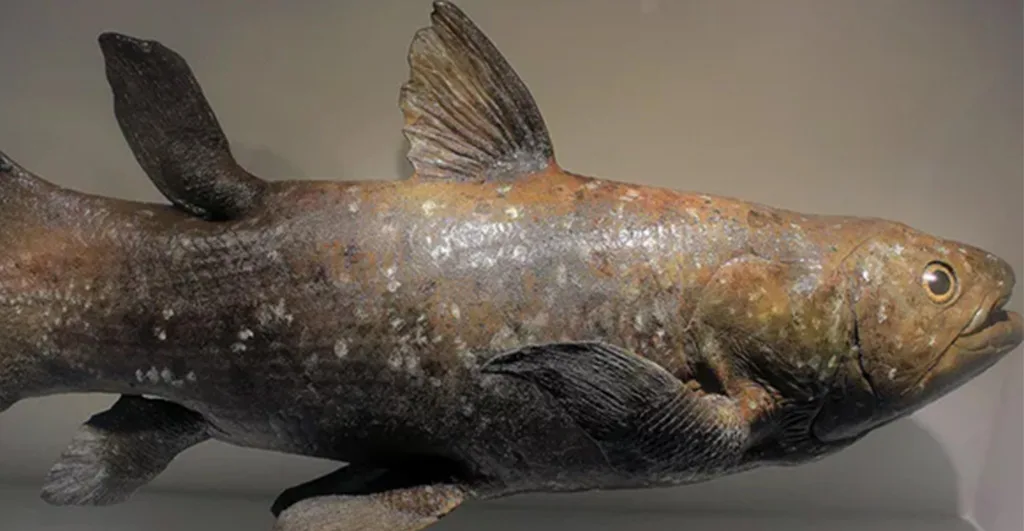
The coelacanth is a Devonian lobed-fin fish and a living fossil. Evolution is survival necessity; morphology follows function.
That is why pigs have trotters and we have fingers and toes. I say that again: fingers and toes, not fingers or toes. Pigs appear here for a genetic reason that becomes plain below.
Traits accumulate and are coded in genes inside living cells. Genes are linear molecular sequences; the full complement is a genome. The human genome has some 20,000 genes across nuclear DNA in 23 chromosome pairs plus mitochondrial DNA. Genes instruct cells how to make proteins. Humans are about 99.9% genetically alike and share roughly 98% of their DNA with pigs.
Under ordinary conditions DNA stays aligned with environmental demand. Evolution through natural selection is successful adaptation under harsh change. At the cellular level, evolution is a gradual accumulation of mutations driven by altered DNA, especially in the germ line. Most mutations help survival and can pass down generations. Occasionally they turn harmful.