

Specialist notes and imaging folder for cancer treatment options consult

Insights · Opinion · General Health

Cancer: Contemporary Treatment Options

How surgery, radiation, medical oncology, and gene therapy aim to stop uncontrolled growth, and why staying treatment-worthy still needs host resilience beside the tumour.

In brief

Most cancer-promoting mutations arise from a mix of random DNA-copying errors, environment, and inheritance. Contemporary care for solid cancers rests on surgical oncology, radiation oncology, and medical oncology (chemotherapy, targeted drugs, immunotherapy including CAR-T), with gene editing still under intense study. Remission is never guaranteed. When toxicities limit the plan, host resilience and complementary TCM support sit beside specialist care.

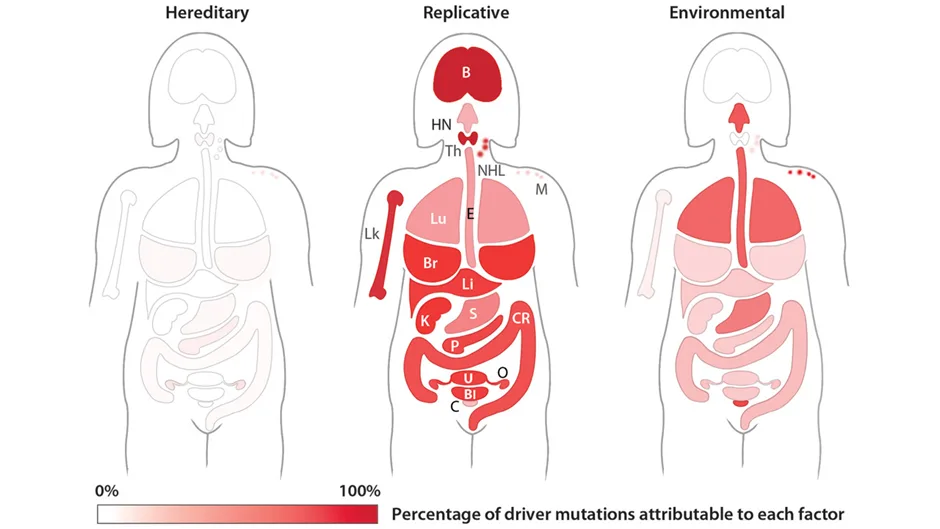
Body map of cancer-promoting mutation sources: replicative, environmental, and hereditary

01 · Causes

Why early detection and treatment stay central

Hereditary · Environmental · Replicative

Across 32 cancer types, Tomasetti and Vogelstein attributed about 66% of cancer-promoting mutations to random errors during cell division, 29% to environmental causes, and 5% to inheritance.

Cancer-promoting mutations arise from hereditary predisposition, environmental exposure, and replicative errors during DNA copying in normal stem cells. Lifestyle change can still cut avoidable risk, yet the 2015 and 2017 Tomasetti and Vogelstein findings reframed how often random “bad luck” during cell division sits behind those mutations.

Most cancers develop from a mix of environment and random replicative errors as a tumour moves from initiation to clinical detection, rather than from a single inherited faulty cancer gene. Inherited predisposition is real, and less common than mutations that accumulate with ageing and division.

The research did not argue for abandoning prevention. It prioritised early detection and effective treatment when disease risk cannot be fully engineered away. The sections below map what contemporary care uses, when each lane fits, and which toxicities most often limit the plan.

Credit: C. Tomasetti et al., Science (2017).

02 · At a glance

Four contemporary treatment lanes

Use this as a decision sketch before the detail sections: when a lane tends to fit, and where it commonly struggles.

Contemporary cancer treatment options: when they fit and where they struggle
Modality When it fits Where it struggles
Surgical oncology Localised solid disease: staging, clear margins, reconstruction, selected prophylaxis Metastatic spread; site-specialist limits; pain, infection, healing, bleeding risk
Radiation oncology Curative or palliative local control; sites the knife cannot reach Site-dependent toxicity; possible later second cancer despite better dosing
Medical oncology Systemic control of primary and metastatic disease (chemo, targeted, immuno/CAR-T) Dose-limiting toxicity, resistance, and serious immune adverse effects
Gene therapy Rewriting defective code; already underpins CAR-T engineering Still heavily researched; remission and metastasis control remain elusive

03 · Clinic lens

How I read these options beside a patient

Orthodox oncology is strongest at rapid disease control. In clinic, the limiting factor is often whether the person can stay treatment-worthy: immune reserve, appetite, sleep, marrow recovery, and the ability to finish the planned cycles without indefinite delay.

Bring pathology, imaging, labs, and discharge notes to any integrative consult. The question is not which modality is “best” in the abstract, but which sequence your specialist team has chosen, which toxicities are already appearing, and whether host resilience needs support so that plan can continue. TCM oncology work at PULSE sits in that complementary lane. It does not replace surgery, radiation, or medical oncology.

04 · Surgery

Surgical oncology

Historically, surgery was the exclusive cancer treatment. Only in the last century did non-surgical means become a common adjunct or, rarely, an alternative. Today surgical oncology remains one of the three pillars for solid malignancies, and often the modality with the clearest chance of cure when disease is still localised before metastasis.

Despite advances across cancer care, surgical oncology has stayed central by folding in technologies such as robotics. Surgery is used for diagnosis and staging, radical removal of a tumour with appropriate resection margins, and debulking when only part of the cancer can be removed safely. After resection, reconstructive work may restore form and function, as in breast oncoplastic surgery or colostomy closure.

In advanced disease, palliative surgery may ease symptoms caused by the tumour. Surgery can also be prophylactic when inherited risk is high, as in double mastectomy and bilateral salpingo-oophorectomy for pathogenic BRCA variants (Angelina Jolie’s public case remains the best-known illustration).

Cancer’s breadth means no single surgeon covers every oncological procedure from head to toe. Like other surgery, oncological operations carry risks of post-surgical pain, infection, healing complications, and internal bleeding.

05 · Radiation

Radiation oncology

Radiotherapy is a primary modality for malignant disease in both curative and palliative settings across almost all solid cancers. It is often combined with surgery, chemotherapy, and other treatments. It is first-line in more than 30% of cancer cases, and about half of patients receive radiotherapy at some point in their regime. Where the knife cannot reach, radiation may still be an option.

Depending on tumour location, radiotherapy may be given as external beam (EBRT), internal radiation (brachytherapy), or radioactive drugs (radiopharmaceuticals). The main objective is to deprive cancer cells of their proliferation potential. Ionising radiation deposits energy in tissue and damages genes. Actively dividing cells are more vulnerable, so rapidly dividing cancer cells and frequently renewing normal tissues are both susceptible.

The practical goal is to maximise dose to cancer cells while limiting exposure to adjacent normal tissue or tissue in the beam path. Normal cells often repair faster than cancer cells, yet treatment still produces radiation-associated toxicities during or long after therapy. Effects are location-dependent and can include fatigue, alopecia, nausea, vomiting, taste change, mucositis, pruritus, dysphagia, oedema, diarrhoea, headache, sexual or fertility issues, cognitive change, and visual disturbance. A later second cancer is also possible. Precision targeting and calibrated dosing have reduced radiotoxicity and second-cancer risk over time, without removing them.

When toxicities start to limit the plan

If recovery between cycles is slipping, bring your specialist notes to an oncology-support consult. Ask for Dr Kevin Tang when TCM oncology is the focus.

06 · Medical oncology

Medical oncology

Surgical oncology and radiotherapy are localised treatments. They work best when cancer remains in situ or has invaded only surrounding tissue, and they are used mainly for solid malignancies. Medical oncology is systemic: drugs and living cell therapies can reach metastatic disease as well as the primary site.

Three medical-oncology lanes. Mechanism first; timing, resistance, and toxicity next.

1. Chemotherapy

Systemic cytotoxics that inhibit proliferation. Cell-cycle specific drugs hit dividing cells; cell-cycle non-specific agents such as cisplatin or cyclophosphamide can hit cells at rest and are often paired with cycle-specific drugs. Neoadjuvant before primary treatment, adjuvant after it, or palliative in advanced disease.

2. Targeted therapy

Interferes with specific proteins and pathways (EGFR, PARP, mTOR inhibitors, anti-angiogenics). Often needs long courses. Early response rates can be high while durability remains limited.

3. Immunotherapy and CAR-T

Harnesses adaptive and innate immunity for longer control. Checkpoint inhibitors such as pembrolizumab (Keytruda) are one path. CAR-T re-engineers patient T cells with chimeric antigen receptors, expands them ex vivo, and re-infuses a living therapy. Cytokine release syndrome is a key serious risk.

Chemotherapy’s non-selective hit on fast-growing normal cells drives early dose-limiting events and can postpone further treatment. In rare settings, cytotoxicity may alter the tumour microenvironment in ways that worsen malignancy. Adjuvant timing is constrained by tumour burden (often discussed with Gompertzian growth models). Genetic change under treatment can produce chemo-resistance, so monotherapy often loses efficacy and combo regimes or cocktails are used. Even so, chemotherapy remains an important enhancer of other cancer treatments.

Toxicities mirror the mechanism: hair follicles, skin, bone marrow, and gut lining are vulnerable. Common effects include myelosuppression, mucositis, nausea, vomiting, diarrhoea, alopecia, fatigue, sterility or infertility, and infusion reactions, with higher infection risk from immunosuppression. Targeted drugs and immunotherapy were developed in part to address those shortcomings: higher selectivity or longer host immune control, each with its own adverse-effect profile.

07 · Gene therapy

Gene therapy and the limits of remission

CRISPR-class gene editing remains heavily researched. In essence it allows versatile, precise manipulation of the genome. Because mutations are changes in base sequence, molecular scissors can rewrite defective code toward an intended form. That opens new routes for previously untreatable genetic conditions, including some cancer settings. Re-engineering T cells for CAR-T therapy is itself predicated on this technology.

Contemporary options can yield clear benefit when conditions are right, yet success stays limited. Disease remission is never guaranteed and is usually qualified as disease-free survival over a defined period. Cancer is rarely only a local problem; given time it may invade surrounding and distant sites. The shared thrust across modalities is to stem replicative potential and uncontrolled proliferation, a goal that remains elusive.

Mutant cells outpace normal cells in growth, demand more energy, and violate contact inhibition. That is how cancer usurps organ space until life-supporting function fails. Death is more often driven by invasion and metastasis, and the complications that follow, than by the presence of mutant cells alone.

Host resilience is the complementary half of that picture. The next piece in this series covers how TCM oncology can sit beside specialist care across neo-adjuvant, adjuvant, maintenance, and palliative stages.

Next: TCM alongside cancer care

Read how debilitation recovery and host resilience can sit beside specialist oncology. Ask for Dr Kevin Tang when oncology support is the focus.

Dr Kevin Tang

Clinically reviewed

Reviewed by Dr Kevin Tang

Consultant Physician · TCMPB T0502026E

MOH-licensed TCM physician with clinical work in TCM oncology, rehabilitation after oncological complications, pain management, and related complex patterns.

View full profile

Educational opinion based on clinical experience and published oncology framing. Not a substitute for oncology, haematology, or other specialist medical care. Does not replace surgery, chemotherapy, radiotherapy, immunotherapy, gene therapy, or other conventional cancer treatments. Speak with your oncology team before changing treatment. Seek urgent care for acute symptoms, fever, bleeding, or emergencies.

FAQs

Questions, answered

Common questions before reading contemporary oncology options beside TCM support.

What are the main contemporary cancer treatment options?

For solid malignancies, care commonly draws on surgical oncology, radiation oncology, and medical oncology. Medical oncology includes chemotherapy, targeted therapy, and immunotherapy such as checkpoint inhibitors and CAR-T. Gene editing approaches such as CRISPR remain under heavy research and also support CAR-T engineering.

What is surgical oncology used for?

Surgery supports diagnosis and staging, radical removal with margins, debulking when full clearance is not feasible, reconstruction after resection, palliative relief in advanced disease, and selected prophylactic procedures when inherited risk is high. Risks include pain, infection, healing problems, and bleeding.

How does radiation oncology treat cancer?

Radiotherapy can be curative or palliative. Delivery may use external beam (EBRT), brachytherapy, or radiopharmaceuticals. The aim is to damage dividing cells while limiting dose to nearby normal tissue. Side effects are site-dependent and can include a later second-cancer risk.

How do chemotherapy, targeted therapy, and immunotherapy differ?

Chemotherapy is systemic and can hit fast-dividing cells throughout the body. Targeted drugs interfere with specific tumour pathways such as EGFR, PARP, mTOR, or angiogenesis, often with high early response but weaker durability. Immunotherapy aims for longer host immune control, with generally lower response rates but better long-term responders in some settings.

What is CAR-T therapy?

CAR-T harvests a patient’s T cells, engineers chimeric antigen receptors that recognise cancer-surface antigens, expands those cells in the lab, and re-infuses them as a living therapy. Serious risks include cytokine release syndrome. It does not replace specialist oncology oversight.

Where does TCM sit after these options?

At PULSE, TCM oncology support is complementary. It may help host resilience and recovery from debilitation so specialist plans remain tolerable, across neo-adjuvant, adjuvant, maintenance, or palliative stages. It does not replace surgery, radiation, chemotherapy, immunotherapy, or other specialist protocols. Bring your reports and ask for a physician who can read them in context.

References

Selected sources

  1. Tomasetti C, Li L, Vogelstein B. Stem cell divisions, somatic mutations, cancer etiology, and cancer prevention. Science. 2017;355(6331):1330–1334. https://doi.org/10.1126/science.aaf9011
  2. National Center for Complementary and Integrative Health. Traditional Chinese Medicine: What You Need To Know. 2019. https://www.nccih.nih.gov/health/traditional-chinese-medicine-what-you-need-to-know/
  3. World Health Organization. Traditional, complementary and integrative medicine. https://www.who.int/health-topics/traditional-complementary-and-integrative-medicine
  4. Ministry of Health Singapore. TCM practitioners (Healthcare Professional Portal). https://hpp.moh.gov.sg/tcm-practitioners/

Book

Start with an oncology-support consult

Share your specialist notes and current treatment stage. We will match you with a suitable physician.

Hours
Most clinics daily 11:00 AM – 8:00 PM
Care
Physician-led consultation